I remember the first time I heard the term “heart language”: June 2010. It was so impactful, I used it as a post title on my missionary blog. Perhaps even now more than then, I can identify.
What’s Your Heart Language?
I began learning Spanish in seventh grade, took four years in high school, and majored in it in college, even spending a semester abroad in Spain during my junior year. Every job I’ve had since graduation has obligated me to use my skills with native speakers. I’ve traveled extensively throughout Latin America and currently live in a non-English-speaking host culture. Though I flub my grammar often, it’s safe to say I’m fluently bilingual.
Spanish is a beautiful language: lilting and romantic without a trace of staccato severity. And yet, even if I were to live here longer than I lived in the US prior to deployment, you can take the girl out of the US, but you can’t take the heart language out of the girl. For me, it will always be English. My parents spoke it to each other while I was in the womb. I was baptized “in the name of the Father and of the Son and of the Holy Spirit” in English. I had a bookshelf full of English books as a child. My family prays before every meal in English. My schooling was in English. I professed my faith at my confirmation in English.
In my heart language, I not only know how words are defined but I also know how they’re connoted. Speech is connected to emotion and carries layers of meaning beyond the pages of any dictionary. No degree program, immersive experience, or gamified app can teach such principles. When my fiancé says “te amo,” I know intellectually he’s saying something sweet; “I love you,” on the other hand, involuntarily triggers my brain to make my facial muscles curl into a smile.
Sharing the Good News with Concordia Gospel Outreach
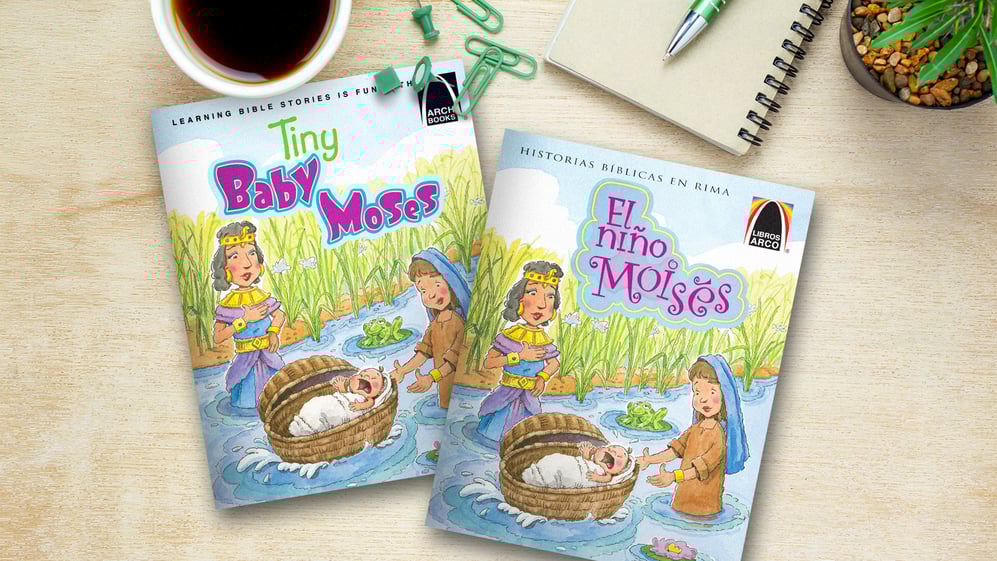
CPH, purveyor of language in its written form that it is, gets it. Thanks be to God for a $125,000 LWML mission grant that will enable Concordia Gospel Outreach to make 5,000 copies each of five different Arch Book titles available in five different languages: Spanish, Chinese, Telugu, Arabic, and Farsi. If you’re doing the math, that’s 125,000 children who will be able to read, mark, learn, and inwardly digest the Scriptures in a most apropos way: “through easy-to-read rhymes and colorful illustrations,” and in the language of their hearts.
The grant is for 2025–27, but the concept of heart languages is not of the future. Men like Martin Luther (German) and Casiodoro de Reina (Spanish) risked their very lives so sixteenth-century commonfolk could read God’s Word in the vernacular. Even in Bible times, hearing the Gospel in one’s heart language was prized. Those gathered for the first Pentecost from all over the known world were “amazed and perplexed” at people telling the mighty works of God in languages they could understand (see Acts 2:1–12). Later in the New Testament, Paul’s diatribe on speaking in tongues beckons the use of an interpreter to “instruct” that the church may be “built up” (see Romans 14:13–19).
The Importance of Language in the Mission Field
Missionary life upholds the concept of heart languages without fail. One can most efficiently and effectively make Christ known in the heart language of one’s constituents. Accordingly, all new LCMS missionaries who deploy to Latin America and the Caribbean (LAC) spend two to four months learning Spanish before they preach a single sermon, take a single photo, or host a single volunteer.
However, the region in which I serve is not unique. Missionaries across LCMS regions, other organizations, and even other denominations also place a high value on language acquisition, because we place a higher value on the acquisition of new souls for Christ. It is the Holy Spirit who calls, gathers, and enlightens, inviting our feeble efforts—and tongues—to contribute in some small way. Romans 8 includes this comforting sentiment: “Likewise the Spirit helps us in our weakness. For we do not know what to pray for as we ought, but the Spirit Himself intercedes for us with groanings too deep for words” (v. 26).
His divine aid transcends the bounds of time, space, and phonology, bearing our petitions of adoration, confession, thanksgiving, and supplication for ourselves, our families, our churches, our communities, and our world before the throne of our heavenly Father in any and every language.
Help Concordia Gospel Outreach share Christian materials with children and families in their native language by giving a financial gift.



.jpg?width=50&height=50&name=IMG_20220621_160541_456%20(1).jpg)