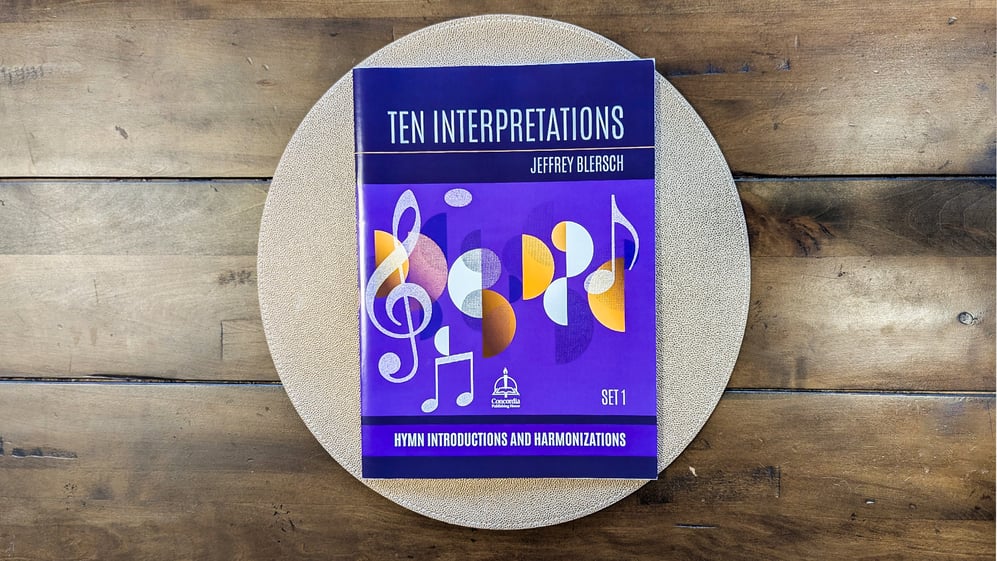
A trusted craftsman at leading engaging congregational singing, Jeffrey Blersch is at it again with a brand-new series of hymn introductions and harmonizations. In this series, ten hymns are treated with an introduction and one or more harmonizations, often with specific stanzas in mind, cementing the connection between words and music, and vividly bringing out the meaning of the text. Use these to uplift, inspire awe, and draw attention to what hymns say.
Blersch’s Introductions and Harmonizations
When accompanying hymns in a congregational setting, organists often appreciate resources beyond the four-part harmonies provided in the accompaniment edition of the hymnal. While the accompaniment edition is the place to begin and provides the bedrock for supporting the congregation, volumes of hymn introductions and alternate harmonizations can add refreshing variety to the hymn-accompanying enterprise.
Dr. Jeffrey Blersch is a professor of music at Concordia University, Nebraska. He is an accomplished organist and composer of choral, organ, and instrumental music. He published ten volumes in his series Introductions, Harmonizations, Accompaniments, Interpretations with Concordia Publishing House from 2005 through 2023.
Blersch’s new series, Ten Interpretations, continues in that vein. The hymn introductions effectively set the tone and tenor of each hymn, and at least one harmonization for each hymn is included. These harmonizations usually correspond to specific stanzas in the hymn in Lutheran Service Book and are indicated as such.
Hymn Harmonizations to Enhance the Text
An effective method of reharmonizing a hymn for congregational singing is text-painting—when the music in one way or another complements the tone and meaning of a specific stanza of text. Many of the harmonizations in this volume are prime examples of text-painting.
An introduction and three harmonizations of “O Sing to the Lord” (LSB 808) are included. While a specific stanza is not designated for the first harmonization, the syncopation throughout the left-hand line would fit well with the third stanza: “So dance for our God and blow all the trumpets. … And sing to our God, and sing to our God.” A bridge and coda are provided at the end of the introduction and harmonizations provide momentum from stanza to stanza.
A harmonization for the second stanza of “O Worship the King” (LSB 804) is included. The first half of the arrangement emphasizes the first and third beats of each measure, providing a galvanizing effect as the congregation sings: “O tell of His might, O sing of His grace, Whose robe is the light, whose canopy space.” In the second half of the arrangement, the pedal line leads a series of chromatic descensions, illustrating the following text: “His chariots of wrath the deep thunderclouds form, And dark is His path on the wings of the storm.”
An introduction and two harmonizations are provided for the tune ICH SINGE DIR, the tune for both “Rejoice, My Heart, Be Glad and Sing” (LSB 737) in B-flat major and “O Christ, Our Hope, Our Hearts’ Desire” (LSB 553) in G-major, making this a versatile inclusion in the volume. In the first harmonization, the melody begins in the pedal line for the first half of the arrangement, and the second half of the stanza features some crunchy, chromatic chords. This arrangement could illustrate the fourth stanza of LSB 737, “And did He not in threat’ning hour Turn dreaded ills away?” or the second stanza of LSB 553, “And bow Your head in cruel death To make us clean within.”
Two stanza-specific harmonizations are included for the tune TRYGGARE KAN INGEN VARA, used for both “Children of the Heavenly Father” (LSB 725) and “See This Wonder in the Making” (LSB 593). Three stanza-specific harmonizations are included for “Glory Be to Jesus” (LSB 433). I recently used the hymn introduction for LOBT GOTT DEN HERREN, IHR—“Sing Praise to God, the Highest Good” (LSB 819)—in a service, and the running eighth-note patterns and registration suggestions successfully prepared the congregation to sing with gusto!
This collection is wonderful to use throughout the year and especially during Lent and Easter, moving into the Time of the Church. Use each one to help set the tone and paint the scene of each service’s readings to delight and inspire your congregation.
Hymn texts are from Lutheran Service Book © 2006 Concordia Publishing House. All rights reserved.
Text for “O Sing to the Lord” © Gerhard Cartford.
Take home this collection by clicking the button below.