Travel exhilarates me. Airport people-watching is a pastime. Hmmm, that’s an interesting outfit. Why is she in such a hurry? Scanning the departure board for my own gate number, I ponder why my fellow travelers are going to Bogotá or Missoula or Queenstown. I flew for the first time before my first birthday, and my current role as an LCMS missionary has made me the kind of jet-setter who has a laminated packing list. Sure, I’ve dealt with my share of lost bags, crew time-outs, and comped hotel rooms, but thankfully, I have relatively few travel horror stories. Nevertheless, travel, especially air travel, calls for a certain degree of letting go; I’m powerless to incentivize a grounded—or MIA—plane to take off on time … or ever.
Letting Go and Trusting God as a Christian
It’s a metaphor for the Christian life. As an eighth grader, I selected Proverbs 3:5–6 as my confirmation verse:
Trust in the LORD with all your heart, and do not lean on your own understanding. In all your ways acknowledge Him, and He will make straight your paths.
It’s a reminder this control freak needs to hear daily: Let go and let God. Much as I like to think I run the show of my own life, it’s not in fact “my own” at all, and much like whenever I fly, I have little say in how my days play out. My thirteen-year-old self had no idea how apropos Solomon’s beckoning would be, years later, as I worry endlessly about what-ifs that would be better laid at the foot of the cross. Thanks be to God for the heavenly help He offers in sticking to each of the passage’s three directives:
- Trust. When my own heart struggles to relinquish command, God answers my prayers for a “clean” one (see Psalm 51:10–12). He doesn’t simply salvage what’s left of the former, either; He starts from scratch, ex nihilo, as at creation, and pours it full of His Spirit.
- Lean. When my understanding is flawed, Scripture assures me that in looking beyond the sinful realm we inhabit, there is rejuvenation (see Romans 12:2). A worldview aligned with God’s own is well attuned with His desire for the good of those who love Him.
- Acknowledge. As author Sharla Fritz points out in Divine Directions, “acknowledge” here means something weightier than nodding to the existence of the one true God; it means “‘to be familiar with,’ ‘to learn to know,’ ‘to be acquainted with,’ and even ‘to know intimately.’” On my own, all hope of being in such relationship with the Almighty evaporates; I need His promised strength from outside myself (see John 14:26).
Straying from God’s Itinerary
Et voilà! Straight paths! Right? In theory. While driving through rural Iowa on a home service furlough assignment, it’s not difficult to envision straight paths. Cornfields on either side of me, I feel like I could set my cruise control and take a nap for miles. Modern road construction equipment uses GPS technology to crisscross terra firma with blacktop in precise rectilinear patterns. To Solomon’s readers, though, the idea of a straight path would have been shocking. Biblical routes were rocky and winding, conforming to the contours of the terrain instead of carving through it.
Sometimes, equipped as I might be to trust, lean, and acknowledge, I still choose a more sinuous route, sliding on loose gravel and tripping face first over tree roots. Sin causes me to meander from God’s uncurving itinerary.
Giving Our Baggage to Christ
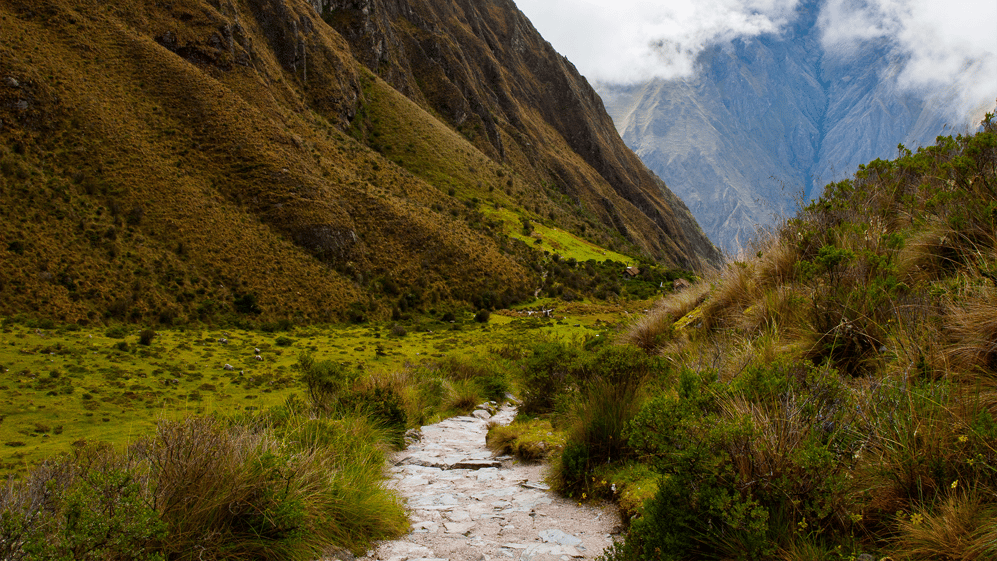
In 2019, I was privileged to hike Peru’s legendary Camino Inka (pictured above). It was a grueling four-day/three-night trek to a vista of Machu Picchu so iconic it looked AI-generated when I finally laid eyes on it. A cadre of porters made it less grueling: Each morning, they’d break camp after we set off, run past us on the trail, often in ratty flip-flops, and set up camp, all before we got there. And by “camp,” I mean bowls of warm water outside our tents to rinse away the trail dust and soothe blistered feet and a multi-course sit-down dinner. As we slogged in, breathing hard, they’d create a tunnel of arms raised heavenward, hands linked, and cheer us along for the final few meters.
However much they—and our guide—directed our path, though, they were unable to make it anything resembling “straight.” The easiest stretches were “Peruvian flat”; as we were high in the Andes, I’ll let you figure that one out. Hiking poles were a must, and the 12,000-plus-foot Dead Woman’s Pass is aptly named.
I’ve thus far failed to mention what’s perhaps the porters’ most important contribution: carrying our belongings. That’s right; they did all of the above loaded down with everything my fellow trekkers and I needed to survive four days and three nights in the wilderness—all the trappings of “glamping” plus our overnight duffels.
The very same heavenly Father who makes our paths through this life straight also carves a way heavenward for us, sending His Son, Jesus, to bear the burden of our sin all the way to the cross. Loaded down with the weight of the world’s iniquity, He died and rose again. His scars are a map that leads to life eternal. So, make sure your seatbelts are securely fastened and your tray tables stowed for takeoff.
Scripture: ESV®.
Quotation in blog taken from Divine Directions: How God Guides Your Path © 2025 Sharla Fritz, published by Concordia Publishing House. All rights reserved.
 Learn more about how God guides your path with a women’s Bible study by Sharla Fritz.






.jpg?width=50&height=50&name=IMG_20220621_160541_456%20(1).jpg)