The Feast of St. Michael and All Angels is celebrated on September 29 of each year. Lutheran Service Book (LSB)contains hymns that fit wonderfully with many of the feasts and festivals, yet you might not know the history about why they were chosen to represent these days. Read about three hymns chosen in LSB for this feast day and the breathtaking history that ties them to St. Michael and All Angels.
Stars of the morning, so gloriously bright (LSB 520)
John Mason Neale (1818–66), in his Hymns of the Eastern Church (1862), called his “Stars of the morning, gloriously bright” (the original first line omitted the word “so”) “a Cento from the Canon of the ‘Bodiless Ones’ ” assigned to “Tuesday in the Week of the Fourth Tone.” A cento is a selection of stanzas from a longer original. A canon in Eastern Orthodox use is a long hymn of around sixty verses divided into eight or nine odes, and the “bodiless ones” are angels. The “week of the fourth tone” refers to the practice in Orthodox churches of singing Matins and Vespers using different liturgical formulas, or tones, each week.
About the Text
There are four different canons titled “of the bodiless ones” in the Orthodox liturgical books, all assigned to Matins, with the fourth such canon assigned to November 8, the commemoration of the archangels Michael and Gabriel and the rest of the bodiless powers. There is also another canon about Michael at Matins on September 6, the “commemoration of the wonder that took place at Colossae through the archangel Michael,” although it is not specifically designated a canon “of the bodiless ones.” Neale’s hymn, though, is a translation of none of these: the most that can be said is that it draws upon some ideas present in the Greek texts.
For example, the Greek texts all emphasize the brightness of Michael and the other angels, as in stanza 1 of LSB, although the angels are never called stars (as in the first line of the English hymn) except once in a passing reference to Satan as the fallen Morning Star. Instead, they are called mirrors that reflect the brilliance of God. The angels are also depicted in the Greek as singing the thrice-holy hymn, the Trisagion, to God, as in stanza 1, line 4 of LSB. The idea in LSB stanza 2, line 4 that angels help human beings is also implied in the Greek, if not stated directly; the Greek texts also list various ranks of angels—cherubim, seraphim, thrones, dominations, virtues, powers, and so on—as does Neale in his original third stanza, which is omitted from LSB. Neale’s original fourth stanza, also omitted from LSB, cites the work of Michael, Raphael, and Gabriel; the Greek verses mention Michael and Gabriel, but not Raphael. These, then, are the similarities between the Greek canons and Neale’s hymn.
It is notable, though, how much in Neale’s hymn is missing from the Greek texts. The ideas about angels as ministers of God in LSB stanza 2 are present only obliquely, if at all, except for the image in line 4 of angels as helpers of humans, which the Greek does contain. The striking image in stanza 3 of the angels shouting for joy at creation is entirely absent from the Greek, as are the plea for angels to continue to assist us and the thought that one day we and the angels together will worship God, both in stanza 4. So of the four stanzas in LSB, only stanza 1 is fully reflected in the Greek, with only minimal correspondences in the other stanzas. The two stanzas omitted from LSB fare only slightly better.
Christ, the Lord of hosts, unshaken (LSB 521)
Peter Prange (b. 1972) wrote this hymn in the fall of 1999. While preparing for the observance of St. Michael and All Angels at the parish in Jacksonville, Florida, where he was pastor, Prange was not satisfied with the existing hymns for this occasion in the Church Year. He explains, “I could find no existing hymn that properly surveyed the scriptural truths of this important festival (not even a mention of St. Michael!), so I decided to write one myself.” The hymn was originally sung to the tune SIEH, HIER BIN ICH (LSB 353).
About the Text
Like all minor festivals, St. Michael and All Angels is properly and ultimately about Christ. Therefore, this hymn begins by telling not the story of Michael the archangel, but rather the story of Christ, who conquered sin, death, and the devil. The phrase “slams them in their steely cage” (stanza 1) is a vivid description.
Stanza 2 refers to the biblical account of war in heaven, with Michael and the hosts of heaven battling Satan. “Cast him earthbound with his angels” is mentioned in the alternate Gospel for the day, as Jesus says, “I saw Satan fall like lightning from heaven” (Luke 10:18). The hymn also describes Satan in terms such as “serpent” (stanzas 2–3), “beast” (stanza 2), “tyrant” (stanza 5), and “foe” (stanza 6).
Stanza 3 travels back to Eden and Genesis 3. The twisting of God’s command began when the serpent asked, “Did God actually say?” (Genesis 3:1). God’s cursing of Satan is also the proclamation of the first Gospel to the world (Genesis 3:15).
Stanza 4 begins, “Jesus came, this word fulfilling.” What word is that? It is God’s word of promise, which concludes stanza 3: “You’ll lie crushed beneath His [Jesus’] feet!” The trampling of Satan occurred at Calvary, with Jesus’ feet nailed to the cross. He “bore the brunt of our temptation” both “on the wretched tree” and earlier, when He was tempted in the wilderness for forty days: He strove with Satan, and He won.
The lightning imagery from Luke 10 appears again in stanza 5. The judgment of Satan bears mentioning. Jesus regularly refers to the devil as “the ruler of this world” in the Gospel of John.
We finally hear about the present work of angels in the last stanza. The description of “angel legions” mirrors Jesus’ words in the Garden of Gethsemane (Matthew 26:53). It is also an interesting term, as the satanic demons gave their name as Legion (Mark 5:9). The description of Satan’s “fiery grave” reflects Revelation 20:10.
Lord God, to Thee we give all praise (LSB 522)
Luther, his most valued partner in reform, Philipp Melanchthon (1497–1560), and their students paid relatively little attention to angels, perhaps as a reaction against medieval veneration of angels as mediators with their own power to direct events on earth. Nonetheless, angels were a living part of the Wittenberg theologians’ faith. In this hymn, Melanchthon expressed his confidence that God, who created the angel hosts, also marshals them for the conflict with Satan that besets individual believers, the Church, and society.
About the Text
God receives the praise in this hymn, not the angels, whom God created. However, the hymn extols God’s protection afforded by these angelic beings who, assembled in the light of their Creator’s throne, are listening to His Word, reflecting the typical Wittenberg focus on God speaking to His creatures. Melanchthon describes the angels’ watchfulness, calling attention to the fact that they, like God, never slumber nor sleep (Psalm 121:4) so that they can be waging constant battle against the enemies of God’s people.
Melanchthon’s deep convictions concerning the eschatological battle between God’s truth and Satan’s deception provide the focus of the hymn, as Melanchthon uses biblical images of the ancient dragon (Revelation 12) and the roaring lion (1 Peter 5:8) to dramatize the real threat to believers from Satan and his forces. This hymn takes particular note of the devil’s striving to divide the Church of Christ, a special concern of the Wittenberg reformers about 1540.
Melanchthon’s confidence in God’s providing protection for His faithful is highlighted in stanza 7: the angel troop stands guard and thwarts the devil’s plans against us.
At the end of this rehearsal of God’s use of the angels to watch over and defend His people, Melanchthon returns to praising God, joining the human voices of those singing the hymn with the songs of gratitude and praise sung by the angels.
Sixteenth-century Lutheran church orders often retained St. Michael and All Angels (September 29) as a day of observance in the congregation, so Melanchthon may have had this festival in mind as he wrote this hymn. The day assumed a broader significance because it was chosen as the day for special thanksgiving for the harvest in Evangelical lands, replacing the Assumption of Mary (August 15), which had served as thanksgiving day in the late medieval ecclesiastical calendar. However, it is just as likely that this hymn simply reflects the piety of the Wittenberg reformers, who had confidence that God, who provides all for His people, had commissioned the angels as just one means by which His protection extends to the saints each day.
Scripture: ESV®.
Blog post adapted from Lutheran Service Book: Companion to the Hymns, vol. 1 © 2019 Concordia Publishing House. All rights reserved.
Hymn text of LSB 521 © Peter M. Prange. Used with permission.
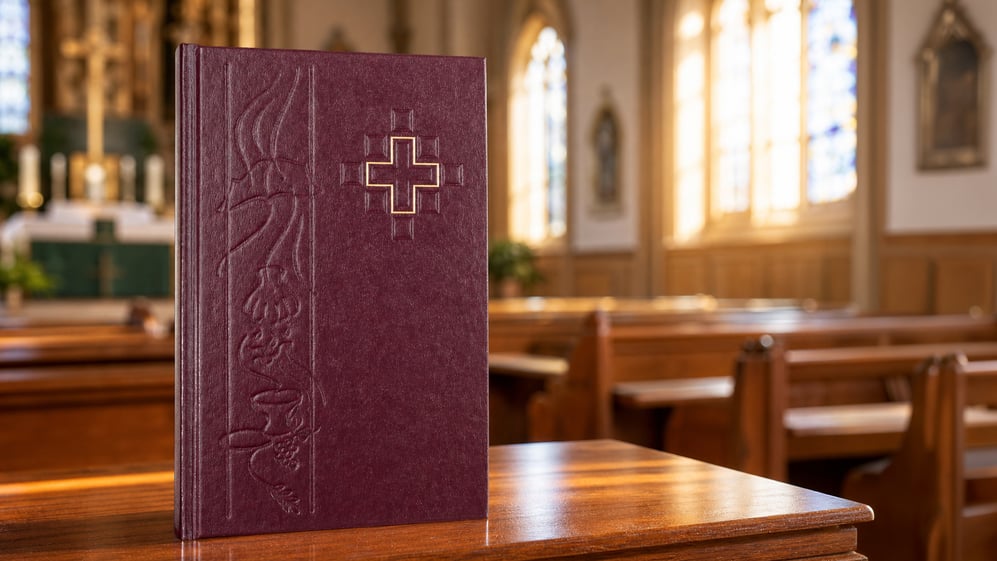
 Find hymns for every season, feast, and festival of the Church Year in Lutheran Service Book: Pew Edition.






.jpg?width=50&height=50&name=IMG_20220621_160541_456%20(1).jpg)