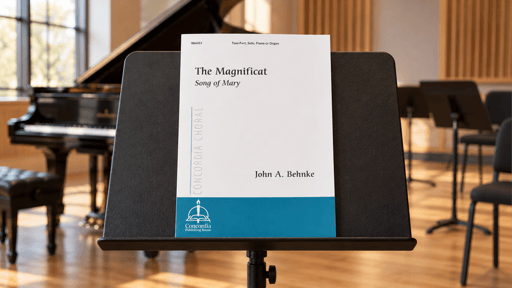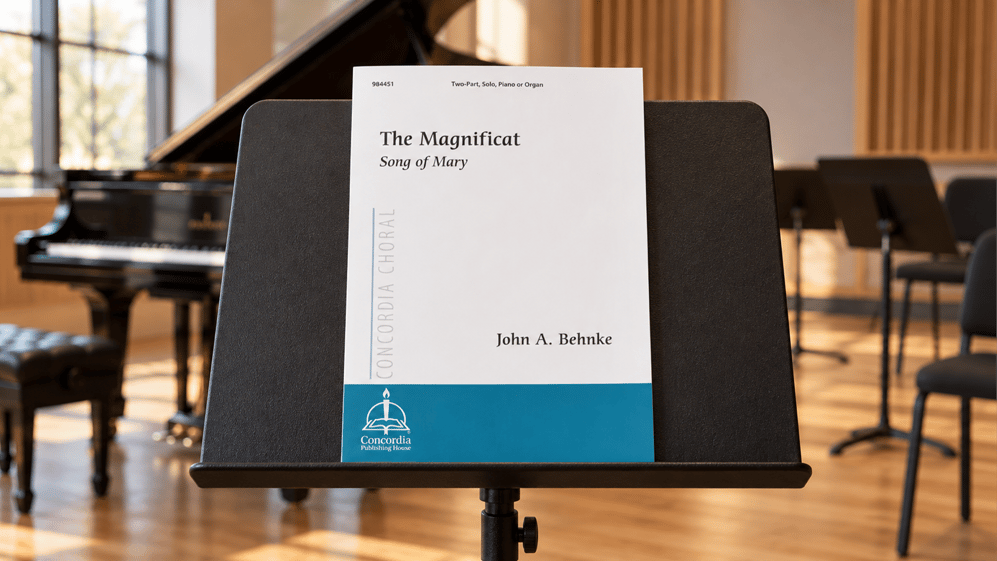
Set with a joyful 6/8 lilt that beautifully reflects Mary’s sense of wonder and expectation, The Magnificat by John A. Behnke is a fresh, accessible musical option for Advent services. The flowing melodic lines and clear textual delivery allow congregations to hear Luke 1:46–55 with warmth and clarity, while the gentle accompaniment provides expressive support. Especially suited for Advent, this setting meets the growing need for strong two‑part literature that works for choirs large and small and serves as a versatile and inviting anthem for the season.
The Text Similarities in Luke 1 and 1 Samuel 2
The Magnificat is Mary’s song from Luke 1. She first sang it after the angel Gabriel announced that she would give birth to the Christ. The church has treasured and proclaimed her song throughout the ages, and we continue to sing it today.
Magnificat is Latin for “magnifies,” from the first line of Mary’s song: “My soul magnifies the Lord” (Luke 1:46). Interestingly, there are strong parallels between Mary’s song in Luke 1 and the Song of Hannah in 1 Samuel 2.
In 1 Samuel 1, Hannah mourns that she has no children because the Lord had closed her womb. She prays fervently for a son, promising that she would dedicate him to the Lord. She ultimately conceives and gives birth to Samuel and sings her song of exultation in the next chapter.
The first line of Hannah’s song—“My heart exults in the LORD. . . . I rejoice in Your salvation” (1 Samuel 2:1)—is almost an exact match to Mary’s song: “My soul magnifies the Lord, and my spirit rejoices in God my Savior” (Luke 1:46–47).
If you look at the two texts side by side, 1 Samuel 2:1–10 and Luke 1:46–55, you’ll notice many more parallels. Perhaps Mary had Hannah’s song in mind and on her tongue as the angel Gabriel visited her on that blessed day.
The Magnificat is the canticle of choice for the evening prayer service in Lutheran Service Book as Evening Prayer and Vespers. It also receives increased attention during the season of Advent as we anticipate the birth of Christ at Christmas, and on the feast of the Annunciation of Our Lord nine months before Christmas, on March 25.
Exploring the Music
Behnke’s setting of the Magnificat is written for two-part voices and a keyboard accompaniment. The keyboard part can be played on either piano or organ, although the arpeggiated chords and rhythm would make the piano a fine accompaniment choice.
The setting begins with a solo voice singing the first two stanzas of the canticle to Behnke’s original tune VENICE. The stanzas correspond to Stephanie K. Frey’s paraphrase of the song, found in LSB 934. This solo treble voice nicely portrays the young maiden Mary singing reflectively at the news she just heard.
The third and fourth stanzas are written for both voice parts. High voices (sopranos and tenors) may sing one part, and low voices (altos and basses) may sing the other. On the third stanza, the low and high voices alternate phrases of the melody, and on the fourth stanza, the low voices sing the melody and the high voices sing a descant.
The melody has a lovely lilt to it, and repeating it through the four stanzas should make it both accessible and memorable for choirs to learn. This piece is a fitting selection for midweek Advent services this year, whether your church follows the order of Evening Prayer or Vespers. It would also be a nice piece for children’s choirs to sing for an Advent or Christmas service or program.
Scripture: ESV®.
Play this piece at your upcoming midweek Advent service or Vespers by ordering the sheet music below.