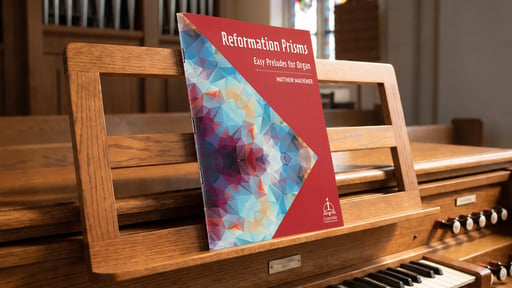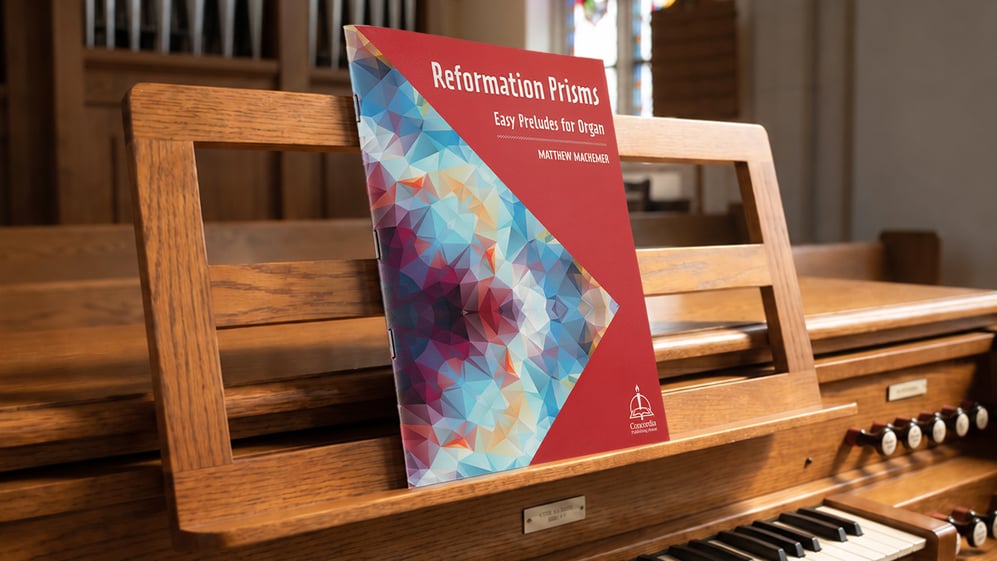
This dynamic organ collection, Reformation Prisms, launches Matthew Machemer’s new Prisms series, presenting bold, stimulating, and highly playable settings of six cornerstone hymns of the church, written with accessibility in mind. Machemer’s style blends rhythmic vitality, clean contrapuntal writing, and strong harmonic momentum. Each setting offers clear structure, satisfying climaxes, thoughtful melodic shaping, and registrations that allow organists to highlight the unique character of each tune. Whether used as hymn introductions, voluntaries, or service music, this collection provides organists with strong, engaging pieces that bring enduring hymn tunes to life with freshness and vitality.
Thy Strong Word
“Thy Strong Word,” set to the formidable tune EBENEZER, is a Reformation Day favorite in many Lutheran churches. But, it isn’t that old. Martin Franzmann (1907–76) wrote it in 1954 in anticipation of the commencement service of Concordia Seminary, St. Louis, in 1955.
Franzmann is known as one of the premier Lutheran hymn writers of the twentieth century. Many of his hymns have prevailed within the corpus of twenty-first-century Lutheran hymnody, but “Thy Strong Word” stands atop the list.
The tune EBENEZER is Welsh, written by Thomas John Williams (1869–1944) at the end of the nineteenth century. Its minor key and galvanizing triplets make it an unforgettable tune to sing. Ralph Vaughan Williams (1872–1958) called it one of the greatest hymn tunes he’d ever heard.
A Mighty Fortress Is Our God
“A Mighty Fortress Is Our God” is known today as the battle hymn of the Reformation, although it didn’t gain that notoriety until centuries after the Reformation. The text is Martin Luther’s paraphrase of Psalm 46. Poetic paraphrases of the Psalms were a popular hymn genre with Luther and the hymn writers that succeeded him.
Luther, also a talented musician, composed the tune EIN FESTE BURG. Two versions of the tune are well known today: the rhythmic version (true to Luther’s original) and the isorhythmic version (used by Bach in four-part chorale arrangements). Machemer’s prelude in this collection is based on the rhythmic version of the tune.
Isaiah, Mighty Seer in Days of Old
“Isaiah, Mighty Seer in Days of Old” is Luther’s expanded version of the Sanctus. The text narrates the scene from Isaiah 6, leading to the familiar, threefold “Holy is God, the Lord of Sabaoth.”
Luther wrote versions of the five ordinary texts of the Divine Service in hymn form in his reform of the Mass. In Lutheran Service Book, these five hymns appear in Divine Service, Setting Five.
Built on the Rock
“Built on the Rock” was written by N. F. S. Grundtvig (1783–1872), a Danish Lutheran pastor. He was a prolific writer, and he faced censorship from political and ecclesiastical authorities throughout his life. That makes for an interesting backdrop to the text of his most well-known hymn.
“Built on the Rock” begins with reference to Christ Jesus’ proclamation to Peter: “On this rock I will build My church, and the gates of hell shall not prevail against it” (Matthew 16:18). The hymn’s tune, KIRKEN DEN ER ET GAMMELT HUS, is both sturdy and soaring. Like EBENEZER, its minor key and strong melodic phrases make for a galvanizing hymn to sing.
Christ Is Made the Sure Foundation
“Christ Is Made the Sure Foundation” is an ancient hymn that dates to the eighth-century Spanish monastic tradition. Paired with Henry Purcell’s (1659–95) noble tune WESTMINSTER ABBEY, it is a triumphant and stately hymn to sing.
In addition to being appropriate for observing the Reformation, this hymn is fitting for the beginning of the service and at any occasion celebrating the church. In the middle ages, it was sung at the dedication of churches.
All Mankind Fell in Adam’s Fall
Although it may not be so synonymous with the Reformation today, “All Mankind Fell in Adam’s Fall” was first written by Lazarus Spengler (1479–1534) in 1524 as a defense of Martin Luther’s theological clarity of Law and Gospel. Matthias Loy (1828–1915) revised and translated the hymn into English, which is why he is credited as its author.
The tune WENN WIR IN HÖCHSTEN NÖTEN SEIN is used today for the text. It’s an introspective change of pace for Reformation Day. Machemer’s prelude on the tune is a light, clean, manuals-only arrangement of the tune.
Scripture: ESV®
Pick up this collection from Matthew Machemer today to play this Reformation Sunday and many more to come.







.jpg?width=50&height=50&name=IMG_20220621_160541_456%20(1).jpg)