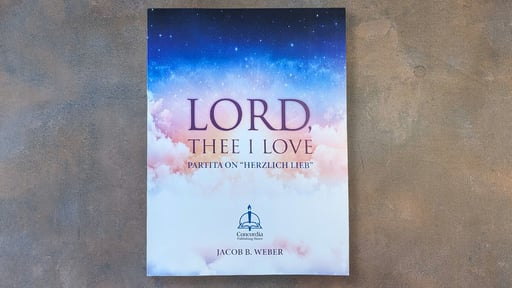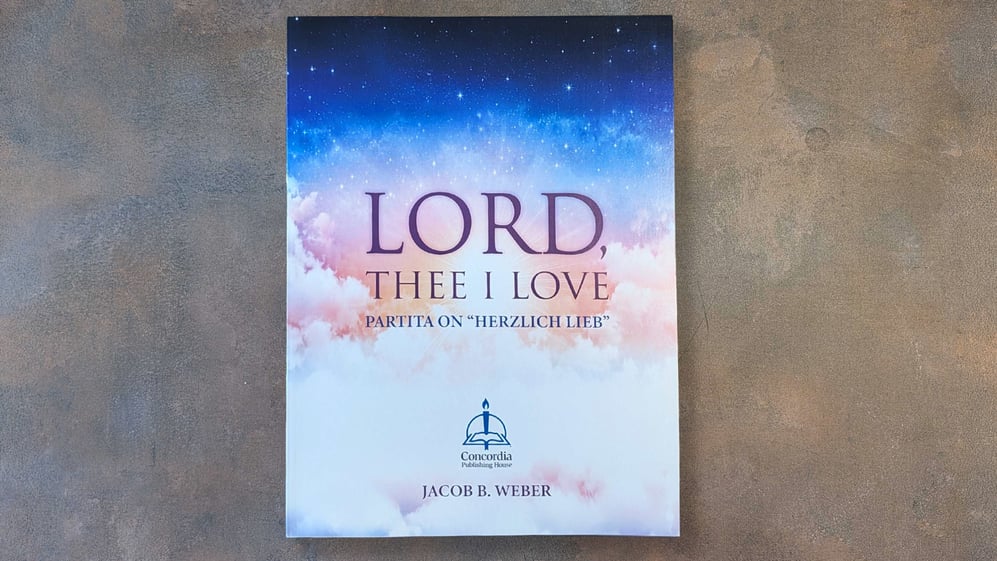
Jacob B. Weber’s Lord, Thee I Love: Partita on “Herzlich lieb” offers a wide‑ranging and thoughtfully crafted exploration of the cherished hymn “Lord, Thee I Love with All My Heart.” Across seven distinct movements, the partita brings forward an array of colors and textures that highlight the depth and character of this historic tune. From a gentle introduction and a full hymn setting to a lively bicinium, atmospheric meditation, and spirited scherzo, each movement highlights a different facet of the melody. The partita concludes with a bold trumpet tune and an energetic, multi‑meter finale, providing organists with a versatile set suitable for service use or recital performance, with movements that work beautifully in sequence or individually.
The History Behind the Hymn
The beloved and famed Lutheran chorale “Lord, Thee I Love with All My Heart” was written by Martin Schalling (1532–1608), a Lutheran pastor in Germany. The first manuscript of the hymn—in Schalling’s own hand—was penned at the conclusion of an Easter Vespers sermon he gave in 1569.
Although there are no explicit Easter or Holy Week references in the text, J. S. Bach (1685–1750) famously included the third stanza of the hymn as the final chorus in his St John Passion (1724). This stanza is a prayer for the Christian at the hour of death, including a dramatic turn in the middle with the words “And then from death awaken me.”
The hymn was translated into English in the mid-nineteenth century. Catherine Winkworth (1827–78), a prolific translator of German Lutheran chorales, translated the majority of the text. It has become a beloved hymn throughout the Church Year, at funerals, and for use during pastoral care.
What Is a Partita in Sacred Music?
A partita is a set of distinct variations based on the same theme. In the context of sacred music, composers write different movements based on the same hymn tune. Partitas gained popularity during the Baroque period (ca. 1600–1750), and the partita remains alive and well today.
The partita is an outgrowth of the suite, which has roots in the Renaissance period (ca. 1400–1600). A suite was a series of dances set to the same musical theme. Like the partita, the movements ranged in character and style.
A partita based on a hymn tune often seeks to capture different aspects of the tune and varying themes from the hymn’s text. Sometimes, a composer will associate different stanzas of a hymn with different movements of the partita, drawing connections between the text and music.
Seven Distinct Movements in this Partita
Jacob B. Weber’s partita on “Lord, Thee I Love with All My Heart” contains seven movements. The first is suitable as a hymn introduction during the church service. The second is an arrangement of the hymn, meant to accompany the third stanza. The arrangement accentuates the course the third stanza takes, from the first half’s “Let at last Thine angels come … that I may die unfearing” to the triumphant “And then from death awaken me … and I will praise Thee without end.” This stanza is a favorite of organists to illustrate as their congregations sing in full voice.
The third movement is a bicinium (“two voices”). The melody is one voice, and the accompaniment is the second voice. Biciniums on the organ are often played with contrasting stops. The fourth movement is a meditation. In contrast with the dramatic third stanza and spritely bicinium, the meditation offers a more serene, relaxed look at the tune.
The fifth movement is a scherzo (from the Italian “to jest”). Musical scherzos are fast, exuberant, and playful. The melody is featured in the pedal line in this scherzo. The sixth movement is a trumpet tune, where the melody is played by a strong solo reed stop. The trumpet tune in music has the character of a stately fanfare.
The seventh and final movement of the partita is a vibrant finale. It changes keys and meter throughout, swelling to a thrilling conclusion. Overall, the partita spans the spectrum of musical variations, providing a range of interpretations of the sturdy tune.
Order “Lord, Thee I Love: Partitia on ‘Herzlich lieb’” to play at an upcoming worship service at your church by clicking the button below.