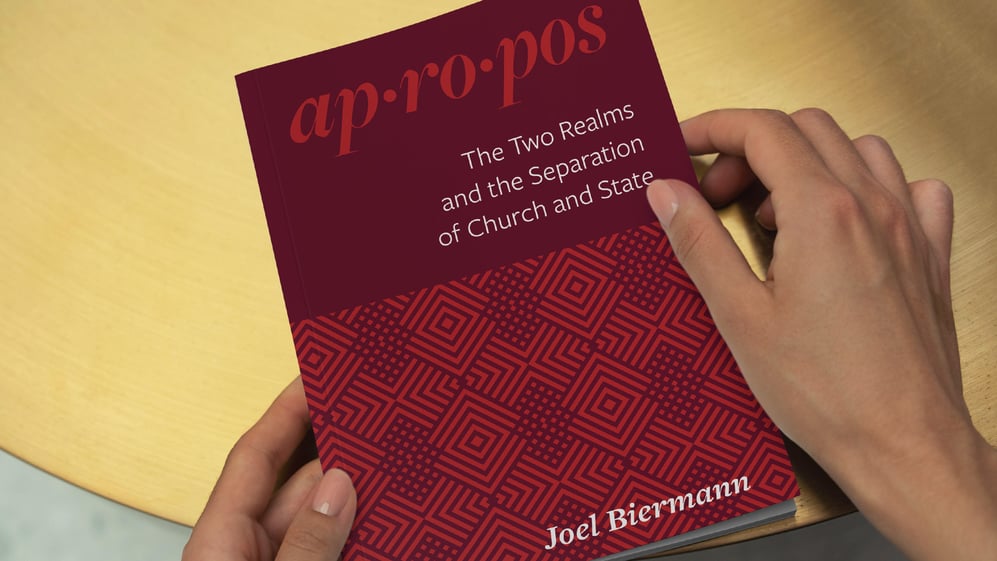
Like most Americans, I was raised to believe there should be a separation between church and state. Christian things belonged in one place, separate from the worldly, earthly parts of our life. It was as if the two should be separated and never touch up against each other. But is that in the Bible? Is that the way God wants it in His world?
Separation of Church and State
The United States is preparing to celebrate its 250th anniversary this coming July 4. When the country was established by the founders, they built into it a definite separation between the church and the state. This wasn’t a decision made in a vacuum; it was a reaction to the European world out of which the founders had come. In Europe, there was a union of church and state that had lasted since the Middle Ages. It resulted in state churches and religious wars that ravaged nations. Wanting to avoid religious intolerance and persecution, the founders decided to separate church from state in the United States of America.
But is that separation what God intended? My context as an American gave me the impression that God didn’t really care about what happened in the state and He only really cared about the church. Just like He didn’t really care if my Northland High School Vikings football team beat our dreaded rival Brookhaven. And, after all, isn’t that what Jesus meant when He was asked if it was right to pay taxes to Caesar and replied, “Render to Caesar the things that are Caesar’s, and to God the things that are God’s” (Matthew 22:21)? God has His things—the church—and Caesar has his things—earthly life. It seems like a clear separation of church and state.
God Works in Both Realms
But my impression that God only cared about Christian, heavenly, spiritual things and not earthly, worldly things, such as family, work, government, and civil affairs, was completely wrong. Martin Luther made that very clear in his explanation of the First Article about creation in the Apostles’ Creed in his Small Catechism:
I believe that God has made me and all creatures; that He has given me my body and soul, eyes, ears, and all my members, my reason and all my senses, and still take care of them. … He richly and daily provides me with all that I need to support this body and life. He defends me against all danger and guards and protects me from all evil.
God not only cares about our physical life; He also cares about His creation and sustains and provides for all creatures, especially we humans who were created in His image. He works through the church as though it was His right hand, bringing sinners to repentance, faith, and forgiveness, while working through the state as though it was His left hand, restraining evil and providing law, security, and order so the church can do its work.
Nothing brings the cooperative relationship between these two realms of God into clearer focus than the incarnation of our Lord Jesus Christ, when He became man and was born of the virgin Mary that first Christmas. He showed God’s concern for our spiritual life by teaching, preaching, casting out demons, and dying on the cross to take upon Himself the punishment for our sins and win forgiveness for us all. And He showed His concern for our physical body by healing the sick, feeding the hungry, raising the dead, and Himself rising from the dead and revealing His risen, glorified body to His disciples over forty days before His bodily ascension into heaven.
When Christ comes again on the Last Day, He will raise our bodies and glorify them, so that we will live with Him forever in the new heavens and the new earth.
God’s two realms of church and state shouldn’t be confused or combined into one, but neither should they be completely separated, because God works through each to care for every single human—body and spirit.
Further Reading on Church and State
We are excited to have launched a new series of compact books, ranging from sixty to one hundred pages, that take on contemporary topics in faith and culture. Each volume helps Christians understand a topic and equips them to engage with that topic in a way that is scripturally and confessionally faithful. Contributing authors are experts in their fields and are known for their insight, confessional integrity, and clarity of writing. Within the series, titles are grouped into one of two categories: Apologetics and Polemics.
Joel Biermann’s Two Realms and the Separation of Church and State is an example of an apologetics volume. In this book, Biermann explores the reasons for America’s separation of church and state and explains God’s ordering of church and state as the two realms in which He works for the orderly functioning of human society and the saving of lost sinners. He explores the Christian’s place in each of these two realms. This is certainly an edifying read for all people navigating their roles as Christian citizens!
Catechism quotations are from Luther’s Small Catechism © 1986 Concordia Publishing House. All rights reserved.
Scripture: ESV®.
 Read Two Realms and the Separation of Church and State for a deeper discussion on the two realms’ complementary functions and distinctions.





.jpg?width=50&height=50&name=IMG_20220621_160541_456%20(1).jpg)