Have you ever been reading the Bible and come across a verse that was confusing? Or have you ever seen or heard someone quote a Bible verse and weren’t quite sure if it was being used accurately? When this happens, I find certain questions help clarify the meaning of such Bible verses. These questions help us to zoom out and see the broader context of the verse. Here are a few of my go-to questions.
1. How Did We Get Here?
The Bible is not a collection of verses. It is a collection of books. These books come in various genres including narratives, letters, and poetry. Chapters and verses were added to these biblical books centuries after each of them was written.
No Bible verse exists without context. One of the most helpful things to do when encountering a confusing verse is to read the verses that lead up to it. Here’s an example.
Philippians 4:13 says, “I can do all things through Him who strengthens me.” It’s a popular confirmation verse. I find it is commonly misunderstood and treated more like a motivational mantra than a Bible verse. I can win this game, get this job, or do whatever I want through Christ, who strengthens me. But if we read the preceding verse or two, we will see the apostle Paul is not talking about accomplishing all things. He’s talking about enduring things. He can endure hunger and plenty, abundance and need. He can go through any situation because Christ is with him and strengthens him.
2. What Happens Next?
Perhaps the preceding verses don’t help, but the subsequent verses will. Here’s another example.
In John 5, Jesus encounters a man who was an invalid at the pool of Bethesda. The man had been disabled for thirty-eight years. Jesus asks him an odd question: “Do you want to be healed?” (John 5:6).
Why does Jesus ask this? Well, what happens next? Jesus heals the man, but it’s a Sabbath day. Jesus tells him to pick up his bed and walk, but it’s a violation of the religious leaders’ interpretation of the Sabbath to carry a bed around. When the man is confronted about breaking the Sabbath, he blames the man who had healed him.
Jesus then sees the healed man later and says another strange thing: “See, you are well! Sin no more, that nothing worse may happen to you” (John 5:14). Why does Jesus say that? Well, what happens next?
The man goes and finds the religious authorities and tattles on Jesus. This healed man’s choice to rat Jesus out results in this: “And this was why the Jews were persecuting Jesus, because He was doing these things on the Sabbath” (John 5:16). Jesus tries to persuade the healed man toward a different way of life. But the healed man chooses to protect himself and curry favor with religious authorities rather than listen to Jesus’ instructions.
When this comes up in the three-year lectionary (Easter 6, Year C), we only read John 5:1–9. We do not hear the full story. Asking “What happens next?” sheds some light on Jesus’ words.
3. Where Are We?
Another contextual question that we can ask is about the setting of the Bible verse. Maps are among the most helpful resources for building biblical fluency. The original recipients of biblical books would have understood the geography and culture of that biblical writing far better than we do centuries later. Understanding where we are can help us see why things play out the way they do. Here’s an example.
In Genesis 37, Jacob is in Hebron. He sends Joseph to go check on his brothers, who were pasturing the flock at Shechem. Joseph goes to Shechem, but his brothers have gone to Dothan. Joseph goes there, and his brothers attack him, strip him of his robe, throw him in a pit, and sell him to slave traders who are coming from Gilead and going to Egypt.
Where are we? Joseph travels from Hebron about forty miles north to Shechem, then another twelve miles north to Dothan. The traders from Gilead come from the east, traveling west. These slave traders would have never traveled through Shechem or Hebron. After they buy Joseph, they continue west until they hit the international trade route between Egypt and the Hittite Empire. Meanwhile, Joseph’s brothers go back home to Hebron on the same paths that Joseph took to get there.
The point is this: If Joseph’s brothers had not moved the flock from Shechem to Dothan, they would never have had the opportunity to sell Joseph to those traders from Gilead.
So, the next time you come across any Bible verse that mentions place names, locate them on a map. See if that helps clarify the story. Look at the context of what comes before and after what you are reading. Such questions may lead to clearer understanding and deeper biblical fluency.
Scripture: ESV®.
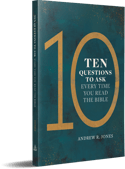 Discover seven more questions you can ask to help you understand the Bible better in Ten Questions to Ask Every Time You Read the Bible.






.jpg?width=50&height=50&name=IMG_20220621_160541_456%20(1).jpg)