Have there been times in your life when you’ve felt like you were at your breaking point? There have been many times in my life when I’ve felt overwhelmed to the point of questioning whether I was able to handle the challenges and situations I’ve faced.
Living in the Midst of Mess
When my husband and I were first married, we bought a fixer-upper house with a lot of confidence and very little skill. This was when DIY home remodeling shows were at the height of popularity, and these kinds of shows make home renovation look easy and seem inexpensive.
When we bought the house, we were newlyweds in our mid-twenties and both in graduate school—we had no real home renovation experience and very little money. We jumped in anyway, and as we were working on the house, we learned that we were expecting our first child.
Shortly before I gave birth, my husband fell through the floor of the tiny room that was meant to be both the nursery and the laundry room. Thankfully, he wasn’t hurt, but that moment felt symbolic of everything I was carrying at that time. Living in the middle of the mess of home renovation, working on my dissertation, preparing to care for a newborn, grieving a sudden death in the family—and then that crash through the floor—pushed me all at once to what felt like my breaking point.
Come to Me, all who labor and are heavy laden, and I will give you rest. Take My yoke upon you, and learn from Me, for I am gentle and lowly in heart, and you will find rest for your souls. For My yoke is easy, and My burden is light. (Matthew 11:28–30)
Distraction Turning to Distress
Many times when we feel overwhelmed, anxious, frustrated, or even bored, we may automatically reach for something to change how we feel. We distract ourselves with movies and TV shows or scroll social media on our phones, looking for anything that will help us unwind. But whether we’re consuming celebrity content or the posts of our own friends, such constant exposure to the lives of others, especially when we’re at a low point, can leave us feeling left behind or inadequate—as if we are doing life wrong. Instead of bringing rest, these habits can increase our anxiety and rob us of joy.
When anxiety takes hold, our minds often move into rumination. Rumination is a pattern of thinking that becomes repetitive, unresolved, and focused on worry. We replay past events, imagine worst-case scenarios, and come back to the same thoughts without finding solutions or relief. How often do you lie awake at night thinking about your problems or other things that trouble you? How often do the same worries surface, with no resolution in sight? I know this pattern well. When I’m facing a problem, my instinct is to try to solve it on my own. Often, that only intensifies my worry.
Where Can You Turn When You Experience Worry?
When my son was in kindergarten, he jumped out of a tree and injured his foot. He wore a cast and rested (which was challenging for a six-year-old in the summer!), but when the cast came off, the pain wasn’t gone. He struggled to walk normally, and no one could explain why. We consulted physicians, physical therapists, podiatrists, and pediatric surgeons, but no one could identify a clear cause or solution. I remember researching any possible avenue that might help—exercises, nutrition changes, supplements—and lying awake at night thinking about how this injury might impact my son’s future. I worried about whether he would be able to play sports, stay active, or even move without pain. My thoughts were intrusive, repetitive, and fixed on the worst-case scenario.
This is rumination. Our brain begins to spiral, and we feel out of control with our problems. Thankfully, there are many wonderful Scripture passages that remind us where to go when we experience such worry.
Do not be anxious about anything, but in everything by prayer and supplication with thanksgiving let your requests be made known to God. And the peace of God, which surpasses all understanding, will guard your hearts and your minds in Christ Jesus. (Philippians 4:6–7)
Along with the everyday worries and anxieties of life, some seasons can feel especially heavy. Serious health concerns, mental health struggles, financial hardship, or sudden loss can leave us feeling overwhelmed—not only by our own pain but by the emotional load we often carry for others as well. When we are struggling, it can be tempting to downplay our pain. We tell ourselves we shouldn’t feel this way or that others have it harder. While those thoughts may come easily, they rarely bring comfort. Instead, they can leave us feeling disconnected from our own emotions.
At times, when I’m hurting, I think that no one could possibly understand all I’m carrying. At other moments, I’m embarrassed by my struggles, believing I should be able to handle them because others are facing more difficult circumstances. Neither of these responses brings peace. Both tend to push me further into isolation. God’s Word reminds us that pain is part of the human experience in our broken world and that it does not need to be justified, minimized, or compared. Pain exists because sin entered the world. Sometimes the amount of pain and suffering that we or others suffer seems unfathomable—the death of a child, chronic pain, a terminal diagnosis, an addiction over which there is no control. Still, amid our pain and suffering, our compassionate God is with us. He is with us in the words of Scripture. He is with us in the gifts of our Baptism (which last forever!). God invites us to bring our anxieties to Him in prayer, trusting His peace to guard our hearts and minds.
Scripture: ESV®.
Blog post adapted from Strong in the Lord: A Women's Bible Study on Faith and Mental Health © 2026 Jennifer K. Londgren, published by Concordia Publishing House. All rights reserved.
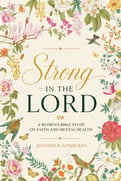 Continue reading to see how you can find peace during difficult times with Jennifer Londgren’s Bible study.