The liturgical colors are those colors that are used for paraments, vestments, and accessories such as banners and other decorations. Color is an adjunct to the worship of the Church but contributes to the times and seasons of the Church Year.
The Development of Liturgical Colors
The use of color in the church building has developed for both psychological and didactic reasons. It is natural to associate certain colors with particular moods, and the mood or tenor of a season of the Church Year is appropriately conveyed by the use of a particular color. The liturgical colors that will be discussed have to do with their evolvement and use in the Western rites of the Church. The association of a color with an attitude or state of mind may vary from culture to culture.
In the Early Church there was no fixed rule for determining the color for a season or festival. Ordinarily the newest and best paraments and vestments were used for the more important occasions. It was not until the sixteenth century that certain colors were assigned for use during particular seasons and on certain feast days. Complete standardization of colors was not achieved until the nineteenth century, and this, as the story goes, was the result of the commercial influence of the ecclesiastical supply houses.
In 1570, with the advent of the reformed missal of Pope Pius V, the common sequence, called “the Roman use,” was established. The high festivals of Christmas and Easter were white. The preparatory seasons of Advent and Lent were violet. The penitential days of Ash Wednesday and Good Friday were black. The days of zeal (Pentecost) and martyrs were red. The other days were green. There is no reason to adhere to this usage. The external matter of color falls under the category of adiaphora or matters that are neither right nor wrong. But since the Lutheran Church is part of the Western rite, it usually follows the customary liturgical practices.
Liturgical Colors During the Church Year
The following is a list of the liturgical colors, describing their significance and use during the Church Year.
White: The color of purity and eternity, symbolizing perfection, celebration, and joy. White is used for Christmas and its season, Epiphany and its season (usually until the Eve of the Second Sunday after the Epiphany), Easter and its season (until the Eve of Pentecost), and also for Holy Trinity and the Christological festivals of the Annunciation, the Visitation, the Presentation, and the Transfiguration. White is used for St. Michael and All Angels and for the festivals of saints who were not martyrs. If Holy Communion is celebrated on Maundy Thursday, the color is white. White may also be used for a mission observance or a day of thanksgiving.
Red: The color of zeal (fire) and martyrdom (blood). Red is the color of Pentecost, from the Eve of Pentecost until the Eve of the Holy Trinity. It is also used for the festivals of saints who died as martyrs. Red is the color for Reformation. It is also appropriate for an ordination, the dedication of a church, and the anniversary of a congregation.
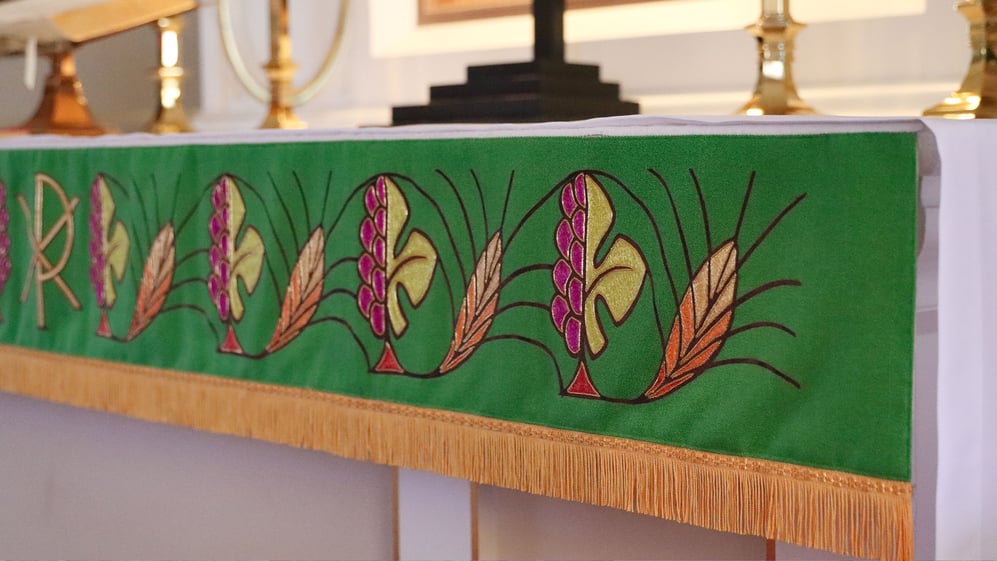
Green: The color of life, refreshment, and regeneration. Green is used for the season after Pentecost, beginning with the Eve of the Second Sunday after Pentecost. It may also be used for the Epiphany season, from the Eve of the Second Sunday after the Epiphany until the Eve of the Transfiguration.
Violet: The color of royalty but also of sorrow and repentance. Violet is used during the Lenten season (until after the Maundy Thursday service, if Holy Communion is not celebrated). It also may be used on a Day of Supplication and Prayer.
Blue: The color of spiritual love, fidelity, anticipation, and hope. Blue is the color for Advent because, since the liturgical revisions of the 1960s, the tenor of the season is one of hope and anticipation of the coming of Christ.
Black: The color of mourning, humility, and death. Black is used on Ash Wednesday (as an alternate) and Good Friday.
Optional Liturgical Colors for the Church Year
The following is a list of optional colors that may be used during certain seasons or on certain days in place of the standard ones described above.
Violet: The color of royalty and repentance, violet is an optional color for the Advent season (until the Eve of the Nativity).
Scarlet: The color of royalty and passion. Scarlet is an alternate color for Holy Week, used until after the Maundy Thursday service (if, contrary to Lutheran custom, Holy Communion is not celebrated).
Gold: The color of riches and glory. Gold may be used on Easter Day, the “queen” of festivals, as an alternate to white.
Rose: The color of anticipation and joy. If a congregation observes Gaudete or Laetare (one-year lectionary), which in the midst of their preparatory seasons anticipate the joy of Christmas and Easter respectively, rose may be used in place of violet.
How to Determine the Color for the Week
The color for the week is determined by the Sunday, except in the case of Christmas (after Christmas it is no longer Advent but the Christmas season, during which season the color white is used). If a feast or festival falls during the week and is observed, the color for that feast or festival is used, but after its observance the color for the week is restored. If a feast or festival is transferred to a Sunday and is observed, the color of the feast or festival may be used on that Sunday, though the precedence of Sundays should make such an observance an exception rather than a rule. Ordinarily, the transference of a feast or festival should not be done during the Time of Christmas or the Time of Easter. The three festivals most commonly transferred to Sunday are the following: St. Michael and All Angels on the Sunday after September 29, Reformation Day on the Sunday before October 31, and All Saints’ Day on the Sunday after November 1. If any of these festivals falls on a Sunday, it may be observed on that Sunday.
It is also important to note that, when employing liturgical colors, it is the season of the Church Year that determines their use. This means that the color of the day or season is not changed for wedding or funeral services. The only exceptions are for services of ordination, church dedication, and congregational anniversary, in which cases red is the appropriate color.
Adapted from The Altar Guild Manual: Lutheran Service Book Edition, pp. 26–28 © 1996, 2008 Concordia Publishing House. All rights reserved.
 Learn more about how to create and maintain a respectful worship space by using The Altar Guild Manual.