The book of Revelation is one of the most controversial books of the Bible. It is the source of speculation about current events, life’s challenges, predictions of the future, and the end times.
Historical Considerations of Revelation
Before reading the text of Revelation, it is important to first consider what the book is about, what its place is in history, what you can expect from reading it, and how you should read it. The Concordia Commentary on Revelation (written by Louis A. Brighton) gives this summary regarding who wrote the book:
The author calls himself “John” (1:1, 4, 9; 22:8), but he nowhere indicates which John he might be. . . . The author just calls himself “John,” without any identifying description such as “apostle,” “disciple,” “son of Zebedee,” or “brother of James.” He assumed that his hearers would know who he was. . . .
. . . All the evidence, when weighed, points to John the apostle and son of Zebedee as the author of Revelation—as well as of the Gospel [of John]. Since there is no compelling evidence to the contrary, and there is persuasive supporting evidence, this commentary is written on the premise that the John mentioned in Revelation 1:1, 4, 9; 22:8 is the John who was one of the twelve apostles and who was the brother of James. (Brighton, 12, 18; brackets added)
Brighton discusses the date of writing in these words:
[Irenaeus] testifies that it was near the end of the reign of the Roman emperor Domitian that Revelation was written. He also says that John was in Ephesus until the time of Trajan. Irenaeus most likely received this information from Polycarp, at whose feet he sat as a young man. Polycarp (ca. 60–ca. 155) was bishop of Smyrna and had sat at the feet of John in Ephesus. (Brighton, 13; brackets added)
Domitian reigned from AD 81–96.
We Are to Prepare for the Prophesied Reign of Christ
Revelation reveals and confirms that Christ was prophetically promised and that His incarnation, death, and resurrection happened so that God’s creation could be restored to its original glory and righteousness. Revelation pictures the exaltation of Christ and what it means for the church. Where the Gospels end at the resurrection and ascension of Christ, Revelation picks up and continues the story from the ascension to the second coming of the Lord—and into eternity.
The hearer and reader are to be ready for what is to come to pass. It is a readiness that comes about through hearing the message. Such preparation consists of baptismal sealing (7:2–3), of being washed in the blood of the Lamb (1:5; 7:9, 13–14; 19:13; 22:14) and through such cleansing to stand ready for the coming of Christ (22:12). As the Christian stands prepared for the coming Lord, he is encouraged in the hope of his faith (2:10) and is inspired for the mission that Christ has given to His church on earth (10:11). (Brighton, 6)
The message of Revelation reveals two ongoing phenomena: the terrifying sufferings on earth and the reign of Jesus Christ as Lord in His heavenly, exalted glory. As these two phenomena are described, God’s people on earth are encouraged to cling in hopeful faith to the eternal heavenly glory that beckons them in Christ’s promise, “Surely I am coming soon,” and in the church’s response, “Amen. Come, Lord Jesus!” (Revelation 22:20).
In short, the more the Christian is confident by faith—strengthened through Word and Sacrament—of going to heaven because of the merits of Christ, the more the Spirit moves the believer to desire to enter heaven. And the more the Christian desires the glory of God in heaven, the more the Spirit moves him to witness through this longing hope of faith. This too is part of the purpose of Revelation: to comfort and encourage the worshiping Christian to pray this prayer of longing and to witness to the world through this worship and prayer. (Brighton, 7)
Theological Considerations for Revelation
Revelation was not the original name of the book. Like most ancient manuscripts, it had no title. Usually, the opening lines of such a book were considered a sufficient title.
In antiquity a title would be a strip or tag attached on the back of a roll; the title was also written inside the roll at the end of the text. . . . The earliest manuscripts of Revelation have the title “apocalypse/revelation of John,” taken from 1:1. (Brighton, 37)
This is the only New Testament book that is referred to as a revelation or a prophecy. As such, it should be viewed in the tradition of the Old Testament prophecies. Note how this prophecy was revealed to John through spoken words and through visions. John’s book describes visions that aid in the revelation. His symbolic descriptions of these visions will be critical to understanding Revelation.
The fact that John understood his Revelation to be a prophecy suggests that he believed this writing would be the last message of God to His people before the End (cf. “prophecy” in 22:18) and that he was the last prophet of the salvation story which had begun with the promise of old and now was concluded in the revelatory-unveiling of Jesus Christ. (Brighton, 38)
Who Gives These Revelations?
In Revelation, as elsewhere in Scripture, God uses mediating angels to communicate His Word. Here, at the beginning, the powerful and exalted Jesus communicates to John through an angelic messenger. Elsewhere in the book, the angels will communicate to John in different ways.
The source of the revelation is God. The mediator of the revelation is Jesus Christ, who uses an angel to give it to John and the churches. Angels play an important role throughout the book of Revelation. They help in the mediation by leading or attending John through the visions. They help in the interpretation of the visions. They also help John to focus on what is important in a particular vision. And they answer John’s questions concerning something within a vision. (Brighton, 38)
This passage closes with a special blessing from Jesus Christ.
Finally, these verses speak a blessing upon “the one who reads [aloud] and those who hear . . . and who keep” this prophetic message (1:3). The blessing is not here defined, but when the six other instances in Revelation of a pronounced blessing . . . are examined, it becomes clear that the blessing bestowed is the participation in the heavenly banquet of the Bride and the Lamb (19:9). (Brighton, 38–39)
Blog post adapted from Revelation, Concordia Commentary Bible Study Series © 2026 Concordia Publishing House. All rights reserved. Italics in original.
Scripture: ESV®.
Quotations from Louis A. Brighton, Revelation, Concordia Commentary © 1999 Concordia Publishing House. All rights reserved.
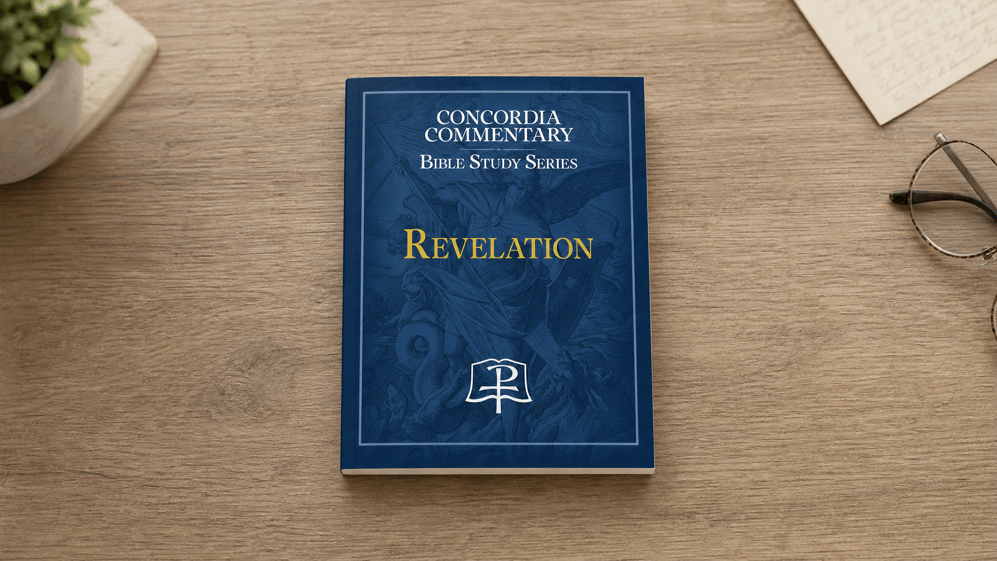
 Learn more about the book of Revelation in this accessible Bible study based on the Concordia Commentary series.