
“You just have to have enough faith.” At first glance, this may sound like good and pious advice. Someone you know may be struggling to make ends meet. He has a bill to pay, but he can’t figure out where he’ll get the money to pay it. And because he can’t see how it will work out, he worries. He can’t stop turning it over in his mind, and he is starting to lose sleep
This blog post is adapted from Soundbite Theology: How to Talk Like a Christian by Joel P. Meyer.
The Truth Behind Comforting Phrases
Or someone you know may have a medical test coming up, and she is afraid of the results. Her lymph nodes have been swollen, and the doctors haven’t been able to rule out cancer. She has spent countless hours on her phone trying to figure out what kind of cancer she may have, what the treatment may be, and what the typical life expectancy is for a disease like this. Rather than trust that God is our Father who will give us what’s good, both of these people become fixated on their problems and the fact that they don’t have an obvious solution.
And so you may feel compelled to say, “You just have to have enough faith.” When people offer this advice, they typically mean, “You have to be more confident in God,” or “You have to turn your worry over to God and let Him take care of it,” or, as it’s often said, “Let go and let God.” See? Good and pious. I mean, isn’t this what we’re supposed to do? Trust God and worry less?
But notice who that statement focuses on. You! You have to trust God more. You have to be more confident in God. You have to turn your worry over to God and “let” Him take care of it. As a result, what does this statement do? It places the burden on the person who is suffering. It’s bad enough that he’s having trouble paying the bills or that she may have cancer, but now this person has to worry about whether he or she is doing enough of the right thing?
And, truth be told, that is usually how this statement ends up getting used: as a guilt trip that this person isn’t doing enough. It easily slips into “If you just had enough faith, you wouldn’t be so worried,” which then slips into “You clearly don’t have enough faith—that’s why you’re so worried all the time.” And from there, it’s not too far a step to “Why do you think God should help you when you clearly don’t trust Him?” Not only is this person suffering, but now he or she has to question whether he or she is in a right relationship with God too.
How Can Faith Be Measured?
And on top of it all, faith is almost impossible to measure. How do we ever know that we trust God enough, that we’re confident enough, or that we’ve turned it over to God enough? Is it when we’re completely worry-free and at peace? Well, if that’s the case, then just a little bit of uncertainty—just a little bit of worry—can lead us to lose confidence in our own faith. We seem like a failure, like we’re not good enough. How can we ever be sure that we’ve done enough?
People don’t usually say, “You just have to have enough faith” because they want to put a guilt trip on someone who is suffering. People say it because they want to encourage others in their suffering, and there is some truth to it. They can and should trust God in these circumstances. But if you want to encourage someone in their suffering, it would be much better to talk not about what they should be doing but about Jesus and what He can do. The Scriptures emphasize faith not to pressure us to try harder but to point us to God and His trustworthiness. Your faith is only as strong as the one in whom you put your trust, and God is the one who gives life to the dead and calls into existence things that do not exist. And in Jesus Christ, God has promised us His unending faithfulness.
How Do We Get Such Faith?
Here is where the phrase “you just have to have enough faith” flounders. Notice again who this statement focuses on: You! You have to trust God more. You have to be more confident in God. You have to turn your worry over to God and let Him take care of it. It says nothing about what God can do, nothing about God’s power over creation, nothing about God’s fatherly goodness and mercy, and nothing about what God has already done for us in Jesus Christ. It lacks all the things that would lead us to put our confidence and trust in God. Instead, it turns our attention back on us and what we’re able to do, which is exactly why we’re worried in the first place.
We don’t have control over our circumstances. We don’t make the sun rise. We don’t cause our own hearts to beat. We can’t bring something out of nothing. We worry when we come to a point where we realize that we are not able. So how are we ever to be confident in God if we’re focused on our own ability? The way we come to be confident in God is not to focus on our ability, but on God’s. When we hear again about God’s power, God’s ability, and God’s faithfulness, those words create the trust that we lack.
Blog post adapted from Soundbite Theology: How to Talk Like a Christian © 2026 Joel P. Meyer. Published by Concordia Publishing House. All rights reserved.
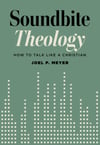 Read more about comforting phrases that might be doing more harm than good (and what phrases you can use instead) in Soundbite Theology.






.jpg?width=50&height=50&name=IMG_20220621_160541_456%20(1).jpg)